
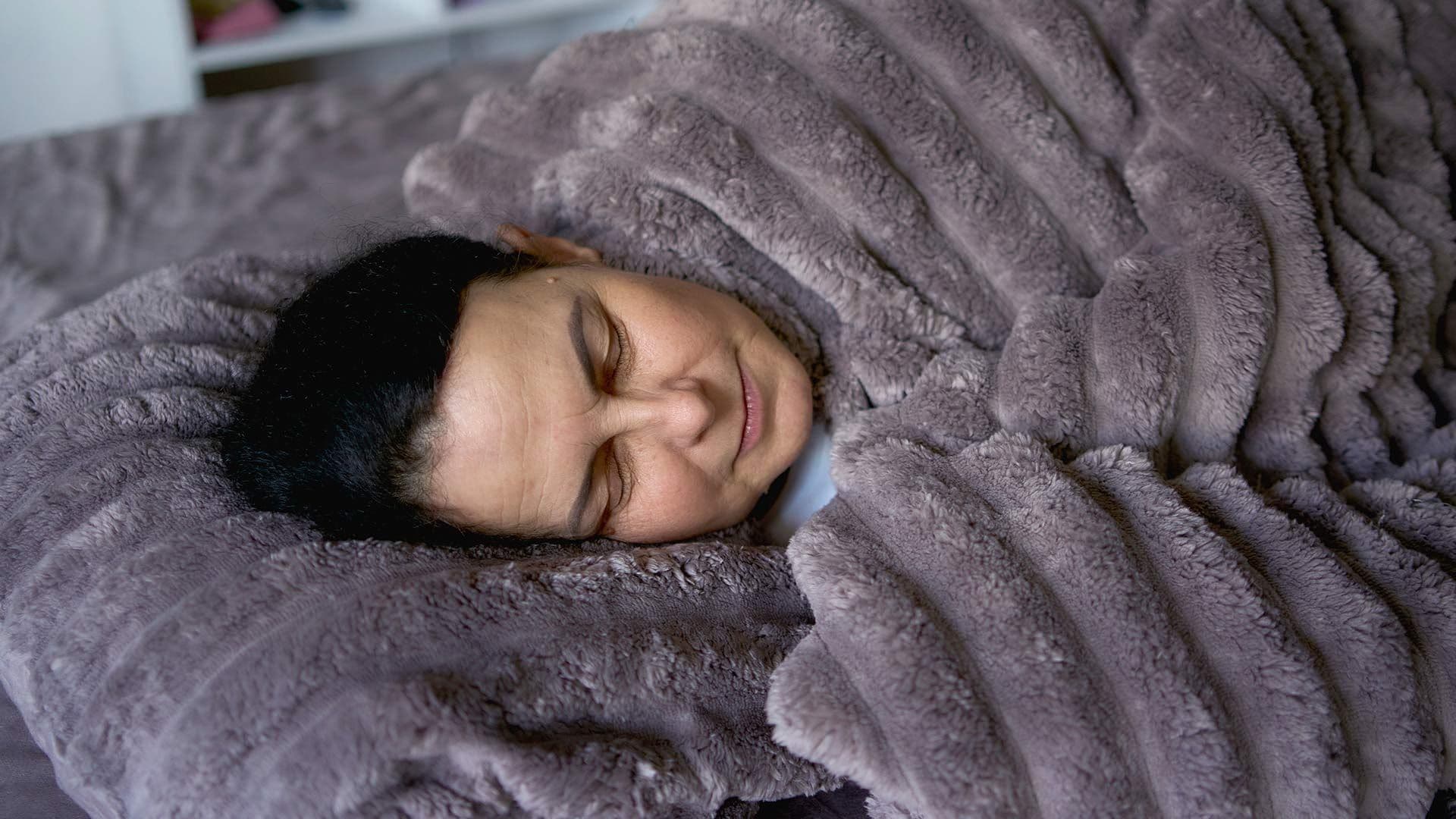
- Up to 90 percent of people with Parkinson’s suffer from sleep problems, mainly caused by the disease-related dopamine deficiency in the brain.
- Sleep disorders should be treated promptly: long-term sleep deprivation can lead to faster disease progression, which in turn can worsen sleep disturbances.
- Special Parkinson’s mattresses, standing aids, support pillows, and relaxation music can improve sleep; health insurance may cover the cost of a bed in certain cases.
- If milder measures have not been effective, a doctor may prescribe a short-acting sleep aid; nighttime levodopa delivery via a pump may also improve sleep quality.
Restless nights, nightmares, and stiff muscles that make it difficult to turn over are part of everyday life for many people with Parkinson’s. The main cause of these widespread sleep disturbances is the Parkinson’s-related dopamine deficiency triggered by neurodegenerative changes in the brain. Sleep deprivation is not only stressful for those affected; their immediate circle often feels the effects directly, such as negative thinking, low mood, exhaustion, and worsened motor symptoms.
We’ll tell you about the helpful resources available to help you sleep better. In addition to special mattresses, standing aids, and relaxation music, medications can provide the relief you’re looking for and give you more energy during the day.
- Sleep Disorders in Parkinson’s Disease Require Urgent Treatment
What aids can help improve sleep in people with Parkinson’s?
- Parkinson’s Mattresses for Better Sleep and Less Pain
- Does health insurance cover the cost of a bed?
- A standing aid helps with standing up and changing positions
- Support pillows and rolls to relieve pressure on muscles and joints
- Smooth fabric makes it easier to twist
- Vibrating watches promote regular movement during sleep
- Side rails on the bed to prevent falls
- Daylight lamps for a more stable sleep-wake cycle
- Heat to Relieve Muscle Tension and Pain
- Pill Dispenser with Alarm Function
- Weighted Blankets for Inner Restlessness
- Relaxation music can gently lull you to sleep
- Medications for a More Restful Night’s Sleep
- Levodopa Pump for Less Discomfort at Night
Sleep Disorders in Parkinson’s Disease: What Are the Symptoms?
Does this sound familiar? Do you have trouble falling asleep at night and often wake up during the night? Sleep disturbances are a major burden, especially when they become chronic. This applies to people with Parkinson’s as well as to those without the disease. When we lack sleep, we lack energy. Our mood takes a hit and our mental performance declines. Fatigue and exhaustion dominate the day—it’s exhausting. The majority of people with Parkinson’s—up to 90 percent—suffer from sleep problems.
Sleep disturbances, which manifest as difficulty falling asleep and/or staying asleep, can be caused by various underlying problems associated with Parkinson’s disease or resulting from comorbid conditions. These include:
- Sore and stiff muscles that make it difficult to turn over and can lead to complete immobility (akinesia) at night. These motor problems can cause you trouble at night because the effects of Parkinson’s medications wear off or because fluctuations in their effectiveness occur spontaneously.
- Twitching, restless legs (an inner restlessness accompanied by a strong urge to move, which manifests as restless legs), or the typical tremors can also be triggered by medications losing their effectiveness and may disrupt your sleep.
- Anxiety and panic attacks make it difficult for you to fall asleep or get back to sleep.
- States of confusion can keep those affected awake.
- Depression accompanied by rumination can make it difficult to fall asleep peacefully.
- Nightmares/REM sleep behavior disorder: In this condition, those affected move excessively during REM sleep. In this sleep phase, the muscles of healthy people are normally inactive. Patients may kick, hit themselves, and scream without even realizing it.
- An increased urge to urinate at night and more frequent urination may force you to get out of bed several times during the night.
- Sleep-related disorders involving pauses in breathing (sleep apnea) can occur alongside Parkinson’s disease, leading to nighttime awakenings or difficulty falling asleep.
- Mental strain and stress often lead to sleep disturbances because the mind cannot settle down.
Causes of Parkinson’s-Related Sleep Disorders
In most cases, the cause of sleep disturbances can be directly attributed to Parkinson’s disease. The problem with this disease is that, over time, a misfolded protein accumulates and clumps together in the dopamine-producing nerve cells of the substantia nigra in the midbrain. This eventually leads to the death of the affected nerve cells (neurons). Unfortunately, these cells cannot simply be regenerated and are therefore irretrievably lost. As a result, the body has too little of the neurotransmitter dopamine available.
The dopamine deficiency causes various motor and non-motor symptoms of Parkinson’s disease, such as tremors, muscle stiffness (rigor), as well as depression, anxiety, sleep disturbances, and a wide range of other symptoms. To learn more about the exact mechanisms behind how Parkinson’s develops and what triggers it, please read our article“Sleep Disorders.”
Sleep Disorders in Parkinson’s Disease Require Urgent Treatment
Since sleep disorders, over time, can lead to negative thinking and emotional distress—and even depression—they should always be treated promptly whenever possible. This is because depression carries an increased risk of suicide. Research has shown that there is a vicious cycle here involving chronic sleep deprivation, progressive degeneration, and worsening symptoms. On the one hand, long-term sleep deprivation leads to a more rapid progression of the disease—that is, a faster loss of dopaminergic neurons. On the other hand, the progression of the disease can in turn exacerbate sleep disturbances.
What aids can help improve sleep in people with Parkinson’s?
But you don’t have to just sit back and accept sleepless nights. There are now effective tools available that can help you improve your chances of getting more sleep, experiencing less pain, and achieving a more restful recovery. In addition to special Parkinson’s beds and mattresses, you can also use sitting-up aids or even medication.
Parkinson’s Mattresses for Better Sleep and Less Pain
For example, resourceful inventors have developed sophisticated mattresses for people with Parkinson’s disease that use small vibrations from a motor to relax the muscles at night, thereby counteracting increasing muscle stiffness and pain through a gentle massage. You can activate this vibration function via an app or remote control. With these modern mattresses, you can also set a schedule in advance for the night. In addition, special Parkinson’s mattresses prevent you from sinking too deeply into the mattress, making it easier to turn over at night. Turning movements can also be initiated and supported by a side-to-side tilting motion of the mattress.
Mattresses ideally tailored to the needs of Parkinson’s patients
These special mattresses are also better at distributing your body’s pressure—which varies from one area to another—than regular mattresses, which can help alleviate pain caused by stiffness or pressure points. This is because they feature differently designed support zones tailored to specific body parts that adapt well to your nighttime movements. In addition, these mattresses are often made of materials that promote freedom of movement and thus allow for minimal friction. This makes it easier for you to change positions during the night. The outer edges, however, are non-slip, minimizing the risk of you falling out of bed.
Flexible joints in the mattress and the matching bed frame allow you to raise your upper body—along with the corresponding section of the mattress—at the touch of a button, using a remote control, or via an app—all without any effort.
Does health insurance cover the cost of a bed?
In certain cases, the cost of a modern mattress and bed frame may be covered in full or in part. This applies if:
- Your doctor certifies that you need such a medical device.
- You experience severe immobility, sleep disturbances, pain, or a high risk of pressure ulcers (decubitus) at night.
- The assistive device you want is listed in your health insurance provider’s assistive device directory.
Long-term care insurance may also cover a portion of the cost of a Parkinson’s bed if it makes home care easier.
A standing aid helps with standing up and changing positions
Handrails—known as triangle handles—that can be installed on the bed can help you sit up more easily from a lying position. They allow you to pull yourself up into a sitting position or move into a different lying position relatively easily using your hands.
Support pillows and rolls to relieve pressure on muscles and joints
Aids such as rolls and pillows stabilize and optimize your position at night, preventing your muscles from cramping unnecessarily and allowing your joints and vertebrae to rest as gently as possible. These include, for example, a side-sleeper pillow that supports your head, shoulders, pelvis, and knees. Rolls or half-rolls can also stabilize certain sleeping positions or help you turn over very slowly, thereby minimizing pain. Placing a roll or pillow between your knees helps reduce pressure on the pelvis, which helps prevent pain and pressure points.
Smooth fabric makes it easier to twist
Satin and silk are your ideal nighttime companions if you’re looking for bedding or nightwear suitable for people with Parkinson’s. These materials have a smooth surface texture, which reduces friction and makes your movements easier. This helps you exert less effort, effectively minimizing pain. Cotton satin or real silk also have the advantage of being breathable and wicking away excess body heat more effectively than non-breathable fabrics. Excessive sweating makes life difficult for many people with Parkinson’s and turns the night into a sweaty, restless experience.
Vibrating watches promote regular movement during sleep
You can also set a vibration alarm on a watch—such as a smartwatch—to wake you up at night, for example, to take your medication. This way, you can prevent your symptoms from returning in the second half of the night due to the natural decline in the medication’s effectiveness, which would otherwise cause you to sleep worse. After a short trial period, you can decide for yourself whether a nighttime alarm helps you or disrupts your sleep.
You can also use a vibration alarm feature to gently remind yourself to turn over while sleeping, as this ability is often reduced in people with Parkinson’s. This can help you effectively prevent stiffness, pain, and pressure sores, and may improve your overall sleep. Users are not intended to be woken up during deeper sleep stages—turning occurs unconsciously during these phases—but this may happen during lighter sleep stages. Again, only you can decide whether this feature helps you or not.
Side rails on the bed to prevent falls
A bed rail that you can raise or lower as needed gives you greater peace of mind at night. It prevents you from falling out of bed and hurting yourself during restless nights. It’s excellent protection and a good investment in your safety!
Daylight lamps for a more stable sleep-wake cycle
The bright light from a daylight lamp can help you wake up more easily in the morning right after you wake up. This is because using the light in the morning—which simulates sunlight with a brightness of 10,000 lux and is directed at you for about 30 minutes—stimulates the production of the wakefulness hormone cortisol and inhibits the production of the sleep hormone melatonin. This helps you feel as alert and in a good mood as possible during the day and get tired in the evening. Daylight lamps can help you counteract sleep-wake disorders.
Heat to Relieve Muscle Tension and Pain
Heat can be beneficial for your muscles, especially if you frequently experience muscle stiffness and pain due to Parkinson’s disease. A heating pad, hot water bottle, or infrared electric blanket can provide your muscles with an extra dose of warmth in the evening before you go to sleep. This increases blood flow to the tissues, relaxes the muscles, and can reduce pain. Ideally, this will also make it easier for you to fall asleep. If pain and muscle stiffness keep you awake at night, applying heat can provide further relief.
Pill Dispenser with Alarm Function
Another helpful invention is a pill dispenser with a built-in alarm clock that you can program to wake you up at night and remind you to take your Parkinson’s medication. This helps prevent the medication’s effectiveness from wearing off during the second half of the night, so that symptoms do not return—or at least not as severely—and you can sleep better.
Weighted Blankets for Inner Restlessness
Do you often feel restless before falling asleep, suffer from restless legs syndrome, or experience anxiety caused by nervousness? If so, a weighted blanket may help. The gentle pressure applied to your entire body has a calming effect on your nervous system, as it has been proven to increase the production of the sleep hormone melatonin. This can help you achieve restful sleep and inner peace. In addition, the pressure from the weighted blanket can give you a sense of safety and security, which is helpful if you experience increased anxiety when trying to fall asleep. Discuss using the blanket with your doctor beforehand, and then find out for yourself whether you find the weight comfortable and whether it helps you fall asleep or not.
Relaxation music can gently lull you to sleep
Relaxing music, such as soothing classical music, and nature sounds—like the sound of the ocean or the gentle chirping of birds—are also great ways to help you drift off to sleep. Just give it a try and listen to soothing, calm sounds right before bedtime to help you fall asleep more easily. Perhaps this will be a way for you to find inner peace and, as a result, fall asleep more easily.
Medications for a More Restful Night’s Sleep
You may need to take medications for certain symptoms in addition to your Parkinson’s medications. This makes sense, for example, if you frequently wake up at night because you feel the urge to urinate. If this is causing you distress and worsening your sleep problems, it’s a good idea to take medications that counteract this. Adjusting your Parkinson’s medication is also often helpful in managing an increased urge to urinate. In addition, you should avoid drinking too much in the evening so that urine doesn’t accumulate in your bladder and your sleep isn’t constantly disrupted.
In the short term, your doctor may also prescribe a short-acting sleep aid if your difficulty falling asleep is severe, has already led to depressive moods and fatigue, and milder measures have not been effective. The following are used in such cases:
- Melatonin
- Low-dose antidepressants (such as mirtazapine, trazodone)
- Low-dose atypical antipsychotics (e.g., quetiapine)
Levodopa Pump for Less Discomfort at Night
If levodopa is also administered at night, the level in the body does not drop, so symptoms do not worsen at night and sleep quality may improve. For patients with severe symptoms, a continuous release of small amounts of the active ingredient day and night is possible, for example, with an L-dopa pump. To do this, a catheter is first surgically inserted through the abdominal wall into the stomach and small intestine. This allows the precursor to dopamine, levodopa, to be continuously delivered to the intestine day and night, but in tiny amounts.