
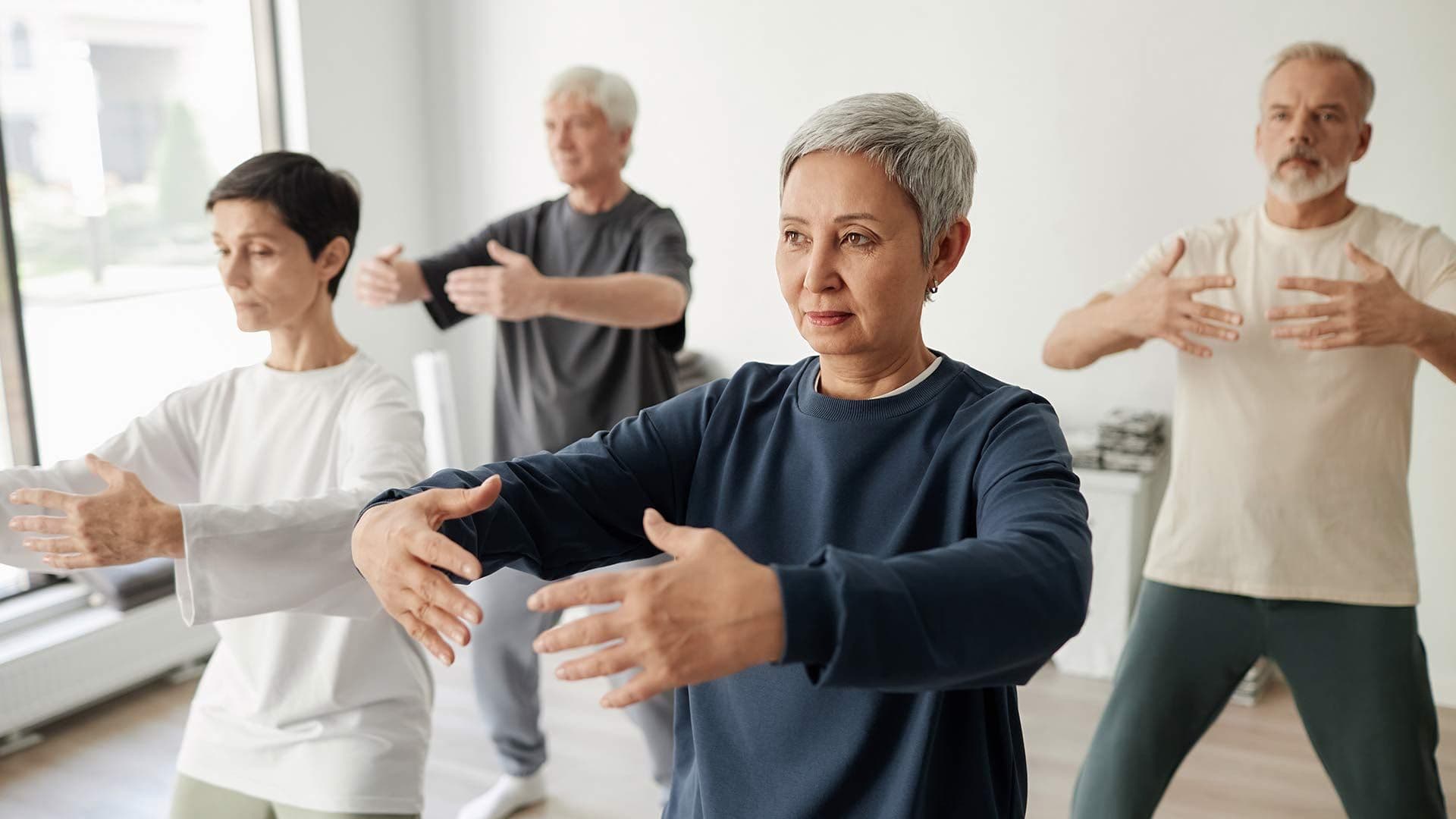
- Qigong is a form of meditation, concentration and movement from Traditional Chinese Medicine, combining breathing, body, movement and concentration exercises.
- According to studies, the slow, gentle movement exercises can have a positive effect on motor and non-motor Parkinson's symptoms and improve quality of life.
- Qigong is considered a very safe method and, according to studies, is generally well tolerated; side effects occur only in rare cases.
- When practising, it is not intensity that matters but regularity; the best way to learn qigong is in a class guided by certified teachers.
Breathing, body, movement and concentration exercises – qigong combines all of these elements in its practices. As an important pillar of traditional Chinese practices, qigong has been used in China for thousands of years to improve physical and mental health. In this country, too, the positive effects of qigong on various illnesses are gaining increasing recognition – and this is also the case for the neurodegenerative Parkinson's disease. Among other things, qigong is said to improve balance, motor skills and muscle strength. In addition, qigong can help you strengthen your life energy and bring more relaxation and inner balance into your life.
We show you what lies behind this method from Traditional Chinese Medicine (TCM), how qigong works, why this meditation in motion is beneficial for Parkinson's and what you need to keep in mind when practising qigong exercises.
What is qigong?
Qigong is a form of meditation, concentration and movement for cultivating body and mind, which is why it is also described as meditation in motion. In China, qigong is something of a national pastime and firmly rooted in the lives and daily routines of many people. Early in the morning, they perform the slow, flowing movements – which also include elements of martial arts – outdoors in parks or other public places, with or without the guidance of a qigong master.
Qigong is made up of the words qi and gong. “Qi” means the universal life energy which, according to TCM, flows through the body's channels (meridians) – similar to our bloodstream. “Gong” means something like “work” or “exercise”. Qigong therefore means working on the qi, on the life force. And this is done through movement, breathing and meditation exercises.
Health goals of qigong
According to TCM, illnesses arise when the qi is disturbed or blocked. Special exercises from qigong or tai chi help to restore the harmonious flow of qi and release these blockages. In Traditional Chinese Medicine, qigong is an integral part of treating existing complaints, but it is also used prophylactically, i.e. preventively, to strengthen health.
In this country, too, qigong is becoming increasingly popular – whether practised on its own or as a complementary therapy. From a Western perspective, regularly practising the special postures and movements of qigong improves our body structure, trains the fasciae (connective tissue) and reduces (chronic) stress. The aim of qigong is to relax the body, improve strength and fitness, calm the mind and stabilise or improve mood.
Types of qigong: Qigong exercises in stillness and in motion
Over time, various styles of qigong have developed from this millennia-old meditation in motion. The two most important forms, which you can learn in a class and practise at any time, are so-called “still qigong exercises” and “qigong exercises in motion”. Both forms aim to guide the qi to specific, energetically blocked regions of the body and get it flowing there.
In meditative exercises in stillness, also called exercises at rest, you achieve this through pure visualisation and special breathing techniques. If anything, small movements that are barely noticeable from the outside can support the process. Still qigong also serves to train (cultivate) the mind. This form of qigong is intended to strengthen abilities such as thinking and memory.
Qigong exercises in motion are somewhat more dynamic and consist of rounded, calm and evenly flowing sequences of movement. In addition, there are further forms:
- Medical qigong: In this form of qigong, health prophylaxis – i.e. promoting health and treating illnesses – comes first. Medical qigong consists of special exercises that focus on particular organs or areas of the body (lung qigong or heart qigong) – for a happy, vital life.
- Spiritual qigong: This spiritual form is the highest category in qigong. You should only practise spiritual qigong if you have sufficient strength and health resources. The exercises are somewhat more demanding and extensive. The main goal: to attain calm, harmony with nature and enlightenment.
Qigong and Parkinson's: Positive effects on body and mind
Exercises from qigong now often have a firm place in Western physiotherapy. The good news: various studies have concluded that the slow, gentle, meditative movement exercises from China can also have a positive effect on the motor symptoms of the neurodegenerative disease – such as bradykinesia, akinesia, rigidity, tremor and postural instability – as well as on non-motor symptoms of Parkinson's disease, including depression, dementia and sleep disorders.
The cause of Parkinson's symptoms is a dopamine deficiency in the black substance (substantia nigra) of the brain. The messenger substance (neurotransmitter) dopamine plays an important role in controlling our movements. In Parkinson's, a dopamine deficiency occurs because the dopamine-producing cells in the substantia nigra gradually die off.
Practised regularly, qigong is also said to improve balance, reduce the risk of falls and has been shown to increase quality of life. The extent to which qigong can positively influence the course of Parkinson's disease could not be clarified on the basis of the studies.
Effects of qigong on Parkinson's
When your body no longer does what you would like it to – and life with Parkinson's becomes ever more challenging – qigong, with its slow movements, calm breathing techniques and mindfulness, can strengthen your body, mind and soul. Qigong is more than movement. With qigong, you can improve your chances of becoming more mobile again, having less pain and maintaining a balanced mood.
Qigong and its effect on the nervous system
Qigong influences our vegetative (autonomic) nervous system, which controls unconscious, vital functions such as heartbeat, breathing, digestion and blood pressure. Supporting this system is particularly important in Parkinson's, as problems frequently occur in this system as well. This is how qigong affects our nervous system:
- The sympathetic nervous system is calmed – this is the part that “revs up” under stress and puts the corresponding areas of the body into a heightened state of readiness.
- The parasympathetic nervous system is strengthened – it ensures relaxation, recovery and regeneration.
- The enteric nervous system in the gut is stimulated – important for healthy digestion.
Health benefits of qigong for Parkinson's
Why is qigong so helpful for Parkinson's? People with Parkinson's frequently experience restricted movement, muscle stiffness, balance problems, inner restlessness and emotional strain. This is exactly where qigong comes in – holistically, on the physical, mental-cognitive and emotional levels:
Positive effects on the physical level:
- Increases the mobility of joints and muscles.
- Helps to release tension and relieve back pain.
- Supports an upright, stable posture.
- Activates lymph flow and the fascial tissue.
- Promotes blood circulation and oxygen supply.
- Stimulates the circulation and supports the immune system in its function.
Positive effects on the mental-cognitive level:
- Contributes to strengthening concentration and memory.
- Stimulates neuronal activity in the brain
- Increases mental flexibility
Positive effects on the emotional level:
- Calms the nervous system.
- Can counteract anxiety and depressive moods.
- Promotes inner calm, joy in life and confidence
Who is qigong suitable for?
Whether young or old, mobile or restricted, full of strength or exhausted – regardless of age and physical condition, anyone can learn qigong. The exercises consist of gentle, flowing sequences of movement that are easy to learn and can be performed standing or sitting, depending on individual ability. Older people or people with physical limitations in particular – as is the case with Parkinson's – can therefore benefit from qigong.
When is medical advice necessary?
In certain situations, medical advice should be sought before beginning qigong practice. This applies in particular to:
- People with severe physical limitations, e.g. after operations or serious illnesses.
- Pregnant women, especially in the advanced stages.
- People taking certain medications, e.g. blood-pressure-lowering drugs.
Also, if you suffer from persistent exhaustion or feel unwell, have the symptoms clarified by a doctor beforehand. If temperatures rise sharply in the summer months, it is better to refrain from practising in extreme heat or to adapt your qigong practice to the individual situation.
Side effects of qigong
In general, qigong is considered a very safe method of improving wellbeing. The slow and gentle sequences of movement, conscious breathing and mindfulness do not place excessive strain on the body. Nevertheless – as with any other practice – unwanted side effects can occur in rare cases, particularly with very intensive or unaccustomed practice:
- Dizziness, headaches or circulatory problems – especially in people with low blood pressure.
- Sore muscles or tension, e.g. due to incorrect posture or excessive strain.
- Emotional reactions such as sadness, restlessness or intense dreams – as qigong can also set emotional processes in motion.
- Overexertion or exhaustion if practising for too long or too often, especially in people with pre-existing conditions.
How safe is qigong to practise?
In the overview study “Safety of Qigong: protocol for an overview of systematic reviews” – published in the journal Medicine in 2018 – researchers examined the safety of qigong in practice and came to the following conclusions:
- Qigong is generally well tolerated and has been described in many studies as having only very few or mild side effects.
- Compared with other forms of exercise such as strength training or endurance training, adverse reactions occur considerably less often with qigong.
However, the researchers also pointed out that only a few studies have recorded side effects so far, which makes the assessment somewhat more difficult. Nevertheless, the analysis provides important information for informed use in prevention and therapy.
Practising qigong exercises: What should you keep in mind?
What should you keep in mind, especially with Parkinson's, if you want to practise qigong? To ensure that you benefit from the exercises safely and effectively, as a beginner you should pay attention to a few points:
- Look for an experienced qigong teacher with experience of neurological conditions.
- Always pay attention to your personal limits and needs – qigong should feel light and pleasant.
- Combine your qigong practice with other therapies such as physiotherapy, speech therapy and occupational therapy.
The best way to learn qigong is in a class under the guidance of certified teachers who have experience working with older people or chronic conditions such as Parkinson's. When choosing, look for the following criteria:
- Qualified training or further education, e.g. through the German Qigong Society (Deutsche Qigong Gesellschaft) or comparable institutes
- Experience with neurological conditions or rehabilitation sport
- The option of adapting the exercises individually (e.g. seated variants, breaks)
Even brief listening to music can bring improvements
Many adult education centres, sports clubs, rehabilitation sports clubs and Parkinson's initiatives offer special exercise programmes for people with neurological conditions. When registering, ask specifically whether the class is also suitable for people with Parkinson's:
- Adult education centres (VHS), health centres, senior citizens' centres or educational institutions in the field of prevention offer qigong classes. Some of these classes are tailored specifically to older people or people with movement restrictions.
- Rehabilitation clinics or specialist neurological centres: Qigong is an integral part of movement therapy. Here, practice is guided under medical supervision and by specially trained therapists.
- Parkinson's self-help groups or regional associations (e.g. through the German Parkinson Association, Deutsche Parkinson Vereinigung e. V.) cooperate with qigong teachers or offer their own exercise programmes.
You can learn and practise qigong in many different ways – what matters is that you feel comfortable in the group and that the exercises are adapted to your needs. After an introductory course, you can also easily integrate qigong exercises into your everyday life and practise within your own four walls or outdoors in the garden or park.
Which exercises are suitable for Parkinson's?
Qigong comprises numerous exercises, including individual exercises as well as more complex exercise sequences. Each form of exercise has its own rhythm, its own breathing and its own effect. People with Parkinson's should choose forms of movement that strengthen and stabilise the body while calming the mind. The goals of the exercises should be to:
- Promote mobility and coordination, because flowing movements are often difficult with Parkinson's. Qigong exercises with wide arm movements, gentle turns and mindful step sequences are intended to help train body coordination. A suitable classic qigong exercise is “The Eight Brocades” (Baduanjin) for mobilisation and strengthening.
- Stabilise posture and train balance. Balance problems are a common issue in Parkinson's. With special qigong exercises, you can specifically train steadiness and balance, improve body awareness and activate the deep muscles. A wonderful exercise for balance would be “standing qigong” (Zhanzhuanggong) – a still form that strengthens inner and outer stability through mindfully holding certain positions.
- Support calm and concentration, because Parkinson's affects not only motor function but can often also impair inner calm and mental clarity. In this case, a suitable exercise with a calming effect on the nervous system would be “qigong for inner nourishment” (Neiyanggong) – a very gentle exercise sequence that is particularly relaxing, promotes concentration and supports regeneration.
Meditation, breathing exercises and mindfulness training are part of many qigong exercises and have a supportive effect in Parkinson's. In addition to qigong, other gentle endurance sports are also recommended to improve mobility, posture, strength and coordination, for example swimming, water aerobics, hiking or Nordic walking.
How often should you practise qigong?
When practising qigong, it is not intensity that counts, but regularity. Only then can the harmonising effect of qigong on body, mind and soul fully unfold. Experienced teachers recommend regular practice – ideally daily, at least two to three times a week.
If you are a beginner, just five to ten minutes a day is enough to notice the first positive changes. Later, you may increase your training to 30 to 45 minutes and, if it really does you good, perhaps even add an extra practice session per day. And always remember: you set the pace – there is no such thing as “too little”.
Once a fixed routine sets in over time – like brushing your teeth every day – qigong is no longer perceived as necessary training but becomes a completely natural part of the day. At first, it may have taken some effort to get yourself to practise, but over time qigong becomes a welcome oasis of calm in everyday life that you certainly won't want to be without.
What clothing is suitable for practising qigong?
Whether in comfortable everyday clothing or a loose tracksuit – the main thing is that you feel comfortable and can focus your attention on the movements and your breathing. So you don't need a special outfit for practising, but there are a few simple recommendations for freedom of movement that make the practice more pleasant:
- Jogging bottoms or yoga trousers should be comfortable and loose.
- T-shirts, sweatshirts or tunics should not be restrictive and should be airy.
- Layering: Wear several layers of clothing depending on the temperature. It should not be too cold or too warm.
- Shoes should be soft, flat and have a thin, flexible sole.
- You can train barefoot or in socks on a non-slip surface.
Good to know: Sturdy trainers are unsuitable, as they prevent contact with the floor and can impair balance.
When is the best time for qigong?
You can practise qigong at any time of day. Whether in the morning in the garden, in the afternoon in the living room or in the evening to round off a long day. Favourable times for qigong practice would therefore be in the morning before 11 a.m., because that is when body and mind are ideally in an alert, calm state and you can build up energy. Midday, on the other hand – between 11.30 a.m. and 1.30 p.m. – is not a good time for qigong practice. Immediately after eating, your body is first of all busy with digestion.
In the afternoon after the lunch break, from 2 p.m. onwards, the digestive system has settled down again. Now the body can once again use a little momentum and energy. The afternoon is also the ideal time for qigong to reduce stress and release tension.
Is qigong for Parkinson's covered by health insurance?
Qigong can be a valuable source of support for people with Parkinson's – promoting mobility, inner calm and quality of life. Many of those affected therefore wonder whether health insurance funds cover the costs of qigong classes or reimburse part of the costs. Under certain conditions, health insurance funds contribute to the costs. It is best to ask your health insurance fund directly whether they provide financial support for qigong classes (online or in person).
Requirements for reimbursement or contribution to the costs
Many qigong classes are certified as prevention courses in accordance with Section 20 of the German Social Code, Book V (§ 20 SGB V). This means they meet certain quality criteria and are recognised by the Central Testing Centre for Prevention (Zentrale Prüfstelle Prävention, ZPP). If you take part in such a course, the following conditions may apply:
- Depending on the health insurance fund, up to 100 per cent of the costs are reimbursed.
- Up to two courses per year from the same area of activity (e.g. exercise) receive financial support.
- The requirement for subsequent reimbursement upon presentation of the certificate of participation and the invoice is attendance at 80 per cent of the course sessions.
Good to know: Are you looking for a recognised qigong class? Then search specifically for a certified qigong prevention course, for example on your health insurance fund's website, or ask your health insurance fund directly by telephone. Otherwise, course instructors can also tell you whether the course is recognised by the ZPP.