Martha Strubinger: Parkinson’s Care Partners Need a Voice
As the wife of a man with Parkinson’s, Martha Strubinger knows how deeply the disease can affect loved ones. The author and Parkinsonpaten volunteer discusses caregiver strain, support groups, writing, honest conversations, and why care partners need space to speak openly.
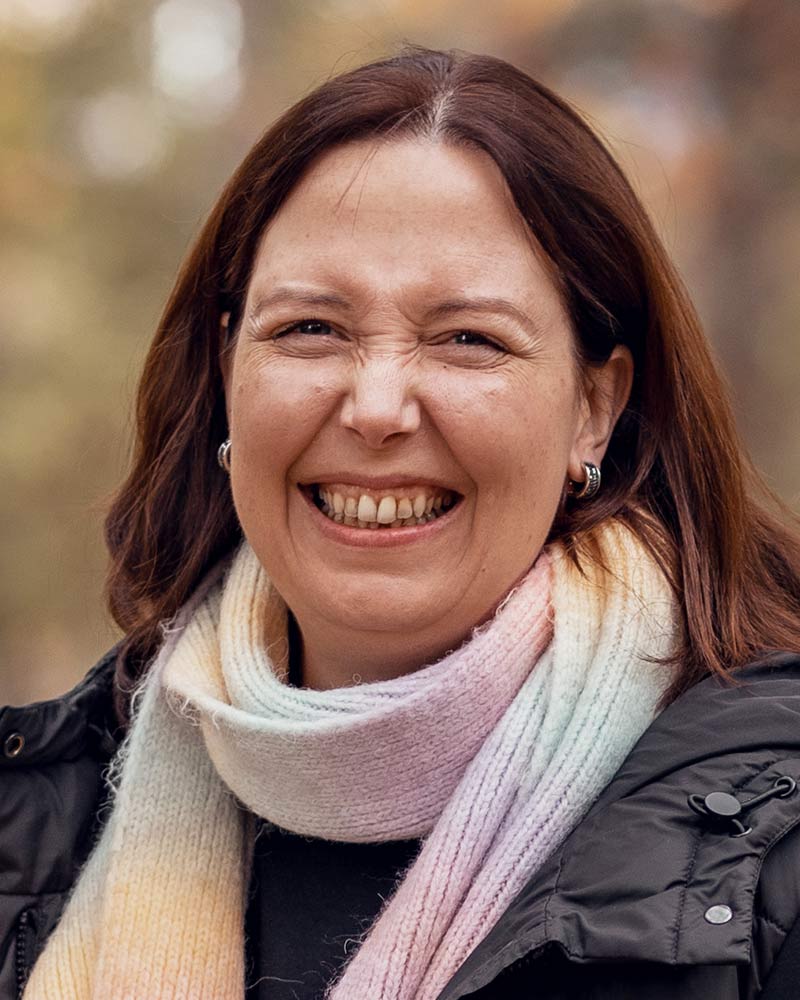
You do not have Parkinson’s yourself, but you still have to live with Parkinson’s. Could you tell us how that came about and what it has meant for you?
Parkinson’s has been part of my life for eight years now. I do not have the disease myself, but my husband was diagnosed with Parkinson’s in early 2018. A few months before that, we had repeatedly noticed a tremor in his right hand. At the time, the doctor simply gave us the diagnosis of Parkinson’s and said there was nothing that could be done at the moment and that we should come back in a year. Until then, we had had no contact with the subject at all and had no idea what it meant. The only thing that came to mind was the question of whether this was the disease Michael J. Fox has.
My husband was hit very hard by the diagnosis. He withdrew and did not want to talk to anyone about it. I, however, have a very different temperament and thought: This is the diagnosis now, so surely there must be a plan for what to do next. So I sat down at the computer and started googling. Pretty quickly, though, I understood that it is a neurodegenerative disease that can be slowed to some extent with certain therapies, but not stopped. That was the first slap in the face we got. At that point, my husband was 49 years old, our adult son was almost out of the house, and we had imagined our lives very differently — fully engaged in our careers, active in our circle of friends, with a full calendar. We were right in the middle of life.
How did you experience those early days as a care partner?
We were lucky to find a very good Parkinson’s specialist to get a second opinion. He spoke with us very openly, almost like family, and took away some of our first fears. He also invited me to accompany my husband to his doctor’s appointments because he always said Parkinson’s does not affect only the person diagnosed; it also affects the relationships around them. Of course, it primarily affects the person with the disease, but care partners and family members also have to deal with Parkinson’s.
At the time, I often wondered what was still ahead of me, whether we were strong enough, and whether we could manage it. There were so many question marks in my mind. Our doctor guided and supported us very well, and at some point I began to see Parkinson’s as something that affects relationships as well — not only the person diagnosed, but also partners, friends, family members, and coworkers. Parkinson’s really is a nasty intruder with many unpleasant surprises in store, not just tremor or rigidity. You have to talk about that within your family and circle of friends, because it is what it is.
What did your husband’s treatment look like, and what did that mean for your everyday life together?
Shortly after the diagnosis, my husband was prescribed physical therapy and exercise, and medication treatment also began right away to bring the tremor under control. Even so, more and more symptoms appeared over the course of that year, and the medication dose was steadily increased. During the first three years, it became clear that my husband’s disease was progressing relatively quickly and that after a certain point, medication would no longer be enough to treat it. At first, the goal was for him to be able to continue working full-time, which is why deep brain stimulation, or DBS, was recommended fairly early. The more new symptoms appeared, the more my husband began to consider that option, although he was not immediately enthusiastic about the idea of having brain surgery. My husband makes every treatment decision himself; I only support him.
We also spoke with other people who had undergone DBS, and in the end, the surgery was performed in December 2023. Unfortunately, it did not go as smoothly as we had hoped. At first, there were problems with the programming: shortly after the surgery, his personality changed — I no longer recognized my husband at all. My greatest fear at the time was whether it would stay that way forever. That would have been truly terrible for me. Fortunately, after a few hard months, my husband looked at me through his own eyes again, and I knew: we can handle this.
How did you deal with the fact that, at least at first, your husband did not want to talk about Parkinson’s at all and withdrew?
It was a very hard year. Each of us felt left alone in our own way, and there was no communication. What helped me was writing everything down — during the first year, I consistently kept a kind of diary. There was a moment when my husband confided in me that he was afraid of developing Parkinson’s disease dementia. That prompted me to also write down beautiful moments from our past in my diary. That is how the book Lebensmensch came about — a German title that roughly means “a person for life.” I gave it to him for our wedding anniversary with the words: “This is not an accusation. It is not my negative feelings. It is my view of things.” At the end of the book, I wrote: “There is only an us!” in the hope that he might open up a little more.
Did your plan work? Did anything change in your relationship and in the way you deal with Parkinson’s in daily life?
He did open up. We started talking about “Mr. Parkinson.” It helps me enormously to separate this intruder, “Mr. Parkinson,” from my husband. On some days, “Mr. Parkinson” is very present. Then it helps me to think: that is Mr. Parkinson talking, not my husband. And then there are the days with my husband, which we enjoy all the more.
How did your friends and family respond to the diagnosis?
I am very grateful for my wonderful social circle. Most people responded very well and continue to accompany us. We still go on vacation together, even though one thing or another may have changed. What is very important is that people do not pity us. I do not like that. Of course, it happens that friends or family members struggle with a symptom or a situation, but from my point of view, that is completely normal. For me, honesty is the most important thing. Even if someone cannot cope with something, that lack of understanding is honest, and I can respond to it.
Did you look for support outside your circle of friends and family?
First, I looked for a support group for care partners and family members, which was not easy to find. There are many support groups for people with Parkinson’s, but very few for care partners. But even talking in the group or among acquaintances was difficult for me because I did not want to speak badly about my husband. I could not say things as they really were.
At first, my husband completely refused to attend support groups because, in his mind, everyone would be sitting in a circle talking about their disease — and that was out of the question for him. After two years, though, he was ready to come along. In Vienna, we found a wonderful group called JUPPS, where people with Parkinson’s and care partners meet together in a small group. It is a very relaxed exchange because the people with Parkinson’s speak openly about the care partners, and the care partners do the same in reverse. Everyone can understand the other side and relate to what is being said. You can get tips and practical strategies for daily life, encouragement, and sometimes also a little perspective when you feel you may be overreacting.
The wonderful thing about our group is how diverse it is. There are both younger and older people with Parkinson’s, newly diagnosed people, and people who have been living with Parkinson’s for many years. You can support and encourage some of them, and from others, you can learn a bit of calm and humor.
Outside the support group, too, we have met many wonderful new people we would never have met without this diagnosis. We have a community, we have support, and we have meaningful exchange.
What are the biggest challenges you experience in everyday life with Parkinson’s?
As a care partner, you are the first point of contact for the person with Parkinson’s, and Parkinson’s makes demands every day, again and again. And demands can quickly become overload. Care partners have the right to say that out loud.
We have always been lucky with our doctors, but in general, I do not think it is the norm for care partners to be so well supported and able to come along to medical appointments. But as a care partner, it is also important to inform yourself about the disease: What are the next steps? What side effects can the medications have? What should I watch for? These observations in particular can also be very helpful for doctors and therapists because people with Parkinson’s may perceive some things differently or may not mention them on their own.
I also do not think it is right that, as the care partner or family member of someone with Parkinson’s, you do not receive psychological support. There should be much better support for that.
Existential worries also play a major role. Often, the person with Parkinson’s cannot work, or at least can no longer work full-time. That means the financial responsibility falls more heavily on the care partner. Together with caregiving and emotional support, this can quickly become a double burden that can lead to burnout.
Were there symptoms that completely surprised you because they were not on your Parkinson’s radar at all? How do you deal with them?
Absolutely. For us, it is REM sleep behavior disorder. Wild kicking, forceful thrashing, combined with loud shouting or crying — it is not exactly harmless when you are the person sleeping next to him. And the resulting sleep deprivation is really intense. It is something that adds another burden to everyday life. You need a lot of humor and a lot of patience to deal with it. I had to learn patience first — I am probably the most impatient person you can imagine. That was a lesson I had to go through. And even today, I do not always manage it, and certainly not every day.
How has the Parkinson’s diagnosis changed your life and your view of the future?
We have stopped putting everything off until later. For example, we started renovating our bathroom as a precaution. We would not have done that without the disease. Bigger trips we are planning are also more likely to happen in the near future and are no longer postponed again and again.
Of course, no one knows what the future will look like, but we do know that it will definitely not get easier. That is why we are already creating beautiful moments now, because we do not know what else that intruder, “Mr. Parkinson,” will come up with. It is important to me that my husband lacks nothing. Right after the diagnosis, the first thing I did was book a flight to Amsterdam because he had always wanted to go there. And I thought: now more than ever.
Your first book was originally intended as a private gift for your husband. Since then, it has not only been published, but has also gained a number of “siblings.” How did you become a published author alongside your full-time job and supporting your husband?
It actually happened completely by chance. I let acquaintances and friends read Lebensmensch. The feedback was wonderful, and above all, there were no books on this topic from the perspective of care partners. That is why I felt a need to stay in that perspective. In spring 2020, COVID came to Austria, and with the lockdown came entirely new challenges for us, which I wrote about in Mr. Parkinson, Corona & der Lockdown (Mr. Parkinson, Corona, and the Lockdown).
Next, I asked many care partners from support groups and online to tell me their stories. That became the care partner project, which found a large readership in manchmal geschüttelt, immer berührt (Sometimes Shaken, Always Moved). My strategy was always to engage with the subject and also to see that not everything is negative. Of course, I would also have been grateful if this cup had passed us by — but it is what it is. So I started writing about it. And because people wanted to read it, the books were published. The fourth book about Parkinson’s is Buntes Mutgeflüster (Colorful Whispers of Courage), in which courageous people with Parkinson’s talk about their daily lives and how they have found ways to cope with the disease.
Money has never been my motivation, which is why I donate all proceeds to Parkinson’s initiatives such as Parkinsonpaten, the Hilde Ulrichs Foundation for Parkinson’s Research, and the Austrian Parkinson’s Society. I want to raise awareness of the issue and encourage family members to speak openly about their challenges in dealing with Parkinson’s without facing hostility. I am committed to ensuring that every family member finds their own way to cope effectively. If I, as a family member, am not emotionally stable, I cannot provide effective support to the person with Parkinson’s.
You are also involved with Parkinsonpaten, a peer mentoring project for people with Parkinson’s and their care partners. How did that come about, and what does your work look like?
My friend Chris founded Parkinsonpaten. Most of the mentors are people with Parkinson’s, so Chris asked me whether I could imagine supporting the project from the care partner perspective. I thought the idea was brilliant and joined right away.
I serve exclusively as a mentor for care partners, and the experience and the number of inquiries show that the need is truly great. Some people need only one or two conversations, while others I accompany for weeks or months. Through WhatsApp, we can stay in close contact.
For many care partners, the initial diagnosis is a major shock. What first piece of advice would you give them?
Breathe. And do not stop breathing. When you start holding your breath, it gets worse. Then you cannot move anymore. Breathe, shake your head out for a moment, and then find a way for yourself to take action: How do I want to handle this situation? What would do me good right now? Who might I be able to talk to?
At the beginning, my husband did not want to talk about it, and he also did not want anyone to know at all. But I told him very clearly: “I am a human being. I have to talk about this. I need to talk with other people. And if I cannot do it with you, then I have to do it somewhere else.”
Can you imagine that an app could help people with Parkinson’s in everyday life — perhaps care partners as well?
I can imagine that very well. In my opinion, any support that is offered will also be used. If that option already existed, I would try it.
What do you wish for the future?
Of course, we all wish for the miracle pill, but even if it came, I do not know whether my husband would still receive it. I am very realistic. The fact is, he has Parkinson’s now. What I wish for the future is a life worth living and a fulfilling life for my husband. I want him, someday, to sit next to me on a park bench and say: “It was still a beautiful life.”
Thank you very much for the interview. We look forward to more books and wish you and your husband all the best.
More exciting interviews
When the voice becomes softer, early support is essential. Dr. Tabea Thies discusses speech therapy, communication, and everyday safety.
Therapy dog Ludwig brings joy to exercise: Prof. Dr. Carsten Eggers combines dog therapy, motivation, and self-efficacy in the treatment of Parkinson's disease.
Monika Morgenthaler knows Parkinson’s from both sides — as a patient and as a caregiver. She talks about caregiving, family, ping-pong, and choosing to make room for joy.
Silvia Lerch supports young people with Parkinson's through self-help, sports, and education—and shows just how much life is still possible despite an early diagnosis.
Josefa Domingos approaches therapy from an everyday perspective—using creative movement techniques, building rapport with patients, and having the courage to rethink Parkinson’s care.
Speech therapist John M. Dean relies on digital therapy, exercise, and motivation—to ensure that support for Parkinson's disease reaches people where they live.
Good Parkinson’s care does not happen in the doctor’s office alone. Carina Lummer focuses on regional networks that support patients and families beyond clinical care.
The gut may play a more important role in Parkinson’s than previously thought. Dr. Arnout Bruggeman discusses microbiome research and new therapeutic perspectives.
A brain pacemaker can significantly alleviate Parkinson's symptoms. Dr. Patricia Krause determines who is a candidate for deep brain stimulation.