Prof. Carsten Eggers: How a Therapy Dog Motivates People with Parkinson’s
Motivation, movement, and self-efficacy are at the heart of animal-assisted therapy for Parkinson’s. Prof. Carsten Eggers, neurologist and chief physician at Knappschaftskrankenhaus Bottrop in Germany, explains how therapy dogs can activate patients and support non-drug treatment approaches.
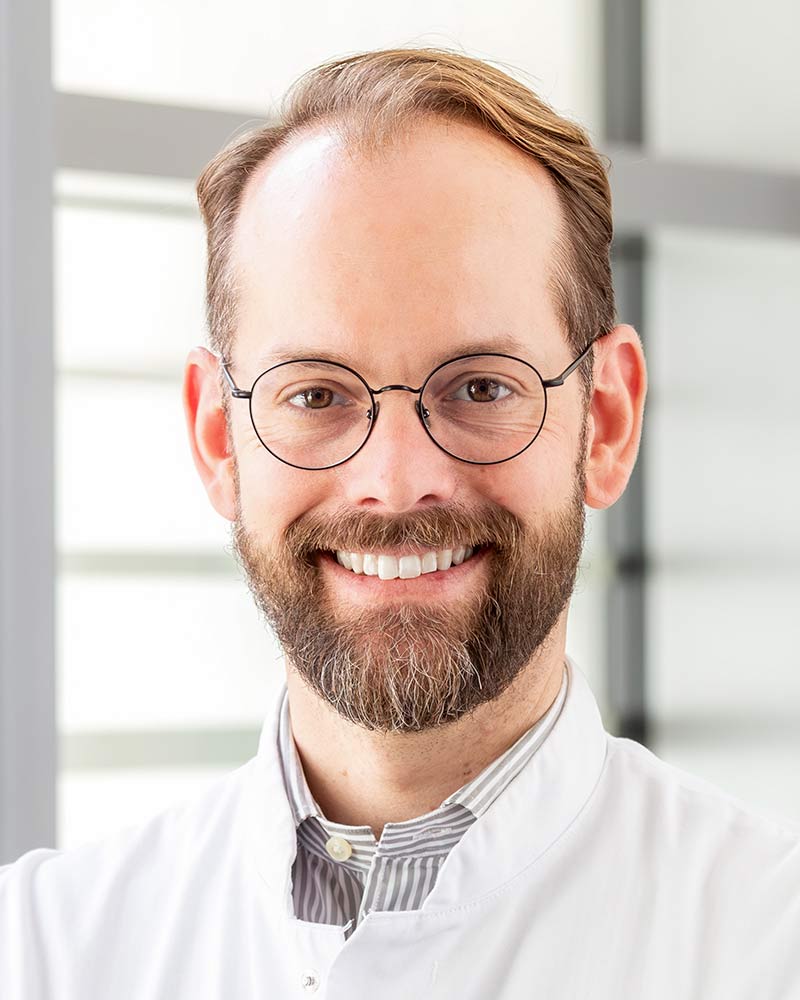
Prof. Dr. Eggers, what motivated you to specialize in the research and treatment of Parkinson’s disease?
The treatment of Parkinson’s patients was one of the focal points of my training as a neurology specialist very early on. I always worked at university hospitals and slowly grew into it. In the beginning, the focus was on clinical care, which developed into my research focus. From the very beginning, I was fascinated by the fact that there is still so much undiscovered about Parkinson’s disease – both in basic science and in care issues. My main focus was initially on imaging: what image patterns can we see in MRI or PET imaging in neurodegenerative diseases? This increasingly led to the question of how to improve the actual care of Parkinson’s patients and their relatives.
Your main areas of treatment include therapy with drug pumps and deep brain stimulation. How did you come to this?
That was also an organic growth. I have always worked at specialist centers that have dealt with complex Parkinson’s patients in particular. Due to the patient population that we and I have treated and are currently treating, these specialized therapy procedures are part of our everyday care. Pump therapy in particular has become even more of a focus in recent years. Among other things, the newly approved subcutaneous L-dopa therapy, which only came onto the German market this year and which we have already used several times with great success, was decisive for this. Deep brain stimulation is always a joint project between neurology and neurosurgery – the neurologists select the patients and look after them before and after the operation, while the neurosurgeons perform the actual operation.
What procedure do you use to select patients for deep brain stimulation, for whom is this therapy suitable and for whom is it not?
This procedure is only suitable for a certain selected clientele. It is not used for patients who have recently been diagnosed or are already in the latest phase of their illness. However, it has shown very good results with patients who have so-called fluctuations in effect – i.e. fluctuations in their symptoms over the course of the day, or patients who suffer from a pronounced tremor. It is always important that the existing symptoms must also respond to medication. On the other hand, pronounced psychological or psychiatric concomitant symptoms, severe depression or hallucinations tend to be exclusion criteria.
What do you see as the current challenge in patient care for Parkinson’s patients in Germany?
The biggest challenge is that we are still only treating the symptoms and cannot get to the root of the disease. In my view, we need to take big steps forward in research over the next few years. We are currently treating the symptoms very effectively and well, but we are still not able to slow down or even stop the disease.
However, very basic care issues in the everyday lives of patients are also rightly criticized time and again. In some areas, there is overprovision, while in others the possibilities are not fully utilized. Leveling this out so that patients can benefit as much as possible from the existing treatment options is another challenge. The goal must be to develop an optimal care pathway so that patients are well cared for from start to finish and the existing resources are used in the best possible way. The challenge here lies primarily in the interaction between inpatient and outpatient care, as well as between doctors and therapists.
What progress has been made in the care of Parkinson’s patients in recent years?
Many small things have improved. There have been no significant milestones, but fine adjustments in the area of deep brain stimulation or improvements in pump therapy have nevertheless contributed to improving the quality of life of patients. You can think of it like a jigsaw puzzle, where you keep finding a missing piece and slowly completing the big picture.
In addition, it has become increasingly clear in recent years that not only drug therapy is the most important component of treatment, but above all non-drug therapies: It is crucial to keep patients moving or to get them moving again. This results in effects that can slow down the disease or mitigate its consequences. With better motor skills, the quality of life increases. Parkinson’s is a disease in which patients can and must do a great deal themselves. Patients’ self-efficacy and self-management have also improved significantly in recent years.
The term “Parkinson’s pandemic” is often used in public, with more and more people (including young people) supposedly falling ill. What is it all about?
The actual proportion of sufferers under the age of 40 is still very small and can usually be attributed to other causes. Typically, young-onset sufferers are genetic carriers of mutations, but these are extremely rare. Nevertheless, it is true that there is a growing number of people with Parkinson’s disease, but this can be explained by two factors: the first is demographics. People are getting older, and the older you get, the more likely you are to develop Parkinson’s disease. In addition, the diagnostic eye has also improved and more people are being diagnosed. The so-called Parkinson’s pandemic, which has been talked about in the meantime, has been put into perspective to some extent. There has been a slight increase and an increase in the number of cases due to environmental factors, but there has not been a sharp rise.
Prof. Dr. Eggers, you are secretary and board member of the German Parkinson’s Society (DPG). What does the society do?
The DPG is a scientific professional society that sees itself as a scientific professional body and deals with scientific issues. However, it is not a patient organization. The Parkinson’s Foundation later developed from the society as a patient organization. The Foundation deals with issues that affect patients and their relatives, while the Parkinson’s Society acts as a mouthpiece for medical professionals. It promotes young scientists and initiates larger research projects. We also organize the German Parkinson’s Congress and work on the guidelines.
You started as Head of Neurology at Knappschaftskrankenhaus Bottrop a good three years ago. Despite your position, you have to share your office. Who is your colleague Ludwig?
Ludwig is a Magyar Vizsla (Hungarian pointing dog) and a trained therapy dog. He works with me primarily with Parkinson’s patients.
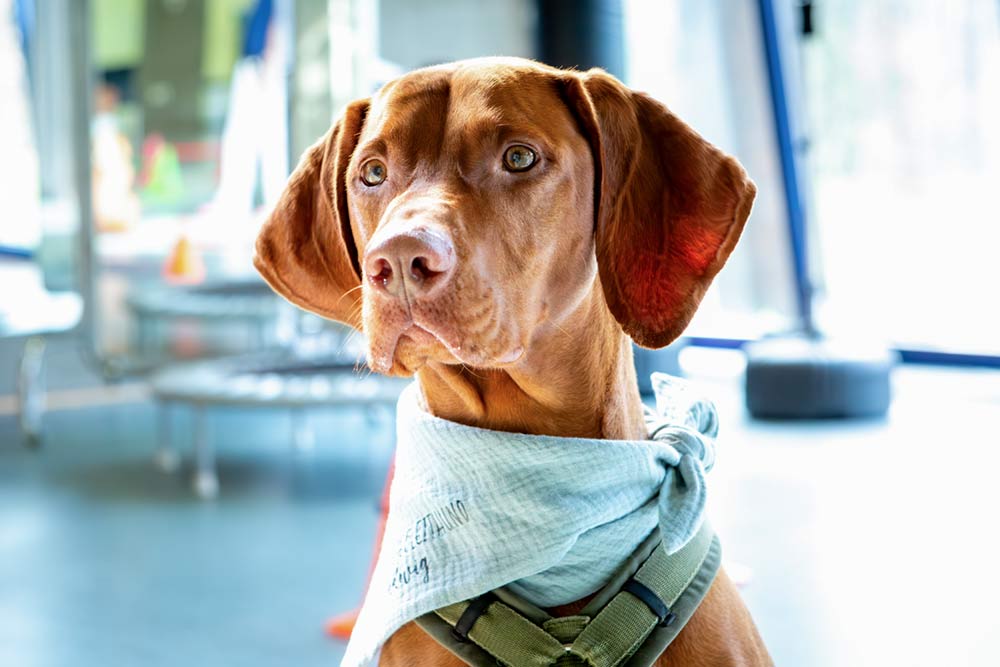
What does a therapy session with Ludwig look like?
This is always a team event and relatively time-consuming. You need a physiotherapist or occupational therapist, the dog handler and, of course, Ludwig. Ludwig is used for the cardinal symptoms, i.e. everything that involves slowing down, encouraging and initiating movement. The dog is primarily a motivator that makes things more fun. For example, the patients build a tower out of soft cardboard boxes and hide treats. Ludwig is then allowed to knock the tower over and look for the treats. He simply joins in, perhaps commenting loudly on the tasks and spreading joy. This makes the patients really work hard. But even if it all sounds like a lot of fun, it’s real work for the dog and very strenuous. That’s why he only works part-time.
Wouldn’t that also be a great idea for other clinics?
My big goal is to scientifically investigate the effectiveness of dog therapy sessions and hopefully be able to prove that they offer clear added value. There is interest from many sides and we receive many inquiries about this. Of course, it would be an advantage if we could prove the success of the therapy scientifically with figures.
How important is interdisciplinary cooperation in the treatment of Parkinson’s patients?
The exchange and cooperation are extremely important, as each discipline has a very high priority. Nursing staff, for example, spend much more time with patients and have a very good eye for symptoms and changes. But all therapeutic disciplines are also extremely important, not only in inpatient settings, but also in outpatient settings. Collaboration can look very different. It is easier in hospital because the distances are short, people know each other personally, regular team meetings take place and there is a close exchange with the patients. As soon as Parkinson’s patients switch to outpatient treatment, communication becomes much more difficult.
Which therapeutic approaches do you consider to be particularly effective?
We carried out a comprehensive Cochrane analysis of which form of therapy is suitable for improving the motor symptoms of Parkinson’s disease and included all available data. The encouraging result was that everything helps. Whether yoga, martial arts, running track training, classical physiotherapy or tango dancing. There is no one therapy, it depends very much on personal preferences and individual symptoms. But what you can say in this case: A lot helps a lot. The recommended minimum amount of exercise is 30 minutes three times a week, but more often is even better.
Could you imagine that an app could successfully supplement and support the therapy of Parkinson’s patients?
As long as the app manages to achieve a positive effect while having fun, I think it’s entirely possible. Patients have to be able to feel the success themselves and want to stay on the ball. What I find particularly exciting in the area of digital support is smart detection of changes in symptoms, perhaps also made possible by motion sensors. This could have a positive effect on care in the future.
You have also dealt with the topic of home-based, local, integrated care for Parkinson’s patients. Why is that important?
For the vast majority of patients, the greatest wish is to remain at home for as long as possible. And to achieve this, we need an environment that takes this into account. How can we meet patients where they live? This has already become possible to some extent during the pandemic thanks to digital ward rounds. But outreach models, where healthcare providers come to patients’ homes and see them in their own environment, are also gaining in popularity.
We doctors lose the patients at some point when they no longer come to the consultation, or perhaps can no longer make it. This is the last mile of the disease, where we are really bad because we lose sight of the patients and the healthcare system is not mobile enough to absorb this.
From this point of view, how important is psychosocial support for Parkinson’s patients and their relatives?
Unfortunately, the disease doesn’t just affect one person, but also their partner and immediate family. It is often a difficult time immediately after the diagnosis is made, because you have the feeling that your whole life is being turned upside down. But the development of the disease also poses major challenges for everyone involved. It is not only the quality of life of those affected that suffers, but also that of the family carers. For this reason, education and support for both patients and their immediate environment are very important.
What role does social education play in Parkinson’s?
In any case, people are already talking more about it. It is no longer a niche disease. Nevertheless, there is still a great need for information about the course of Parkinson’s, the mechanisms of the disease and its development and, above all, the heterogeneity of the disease. As a specialist society, we also endeavor to provide the public with the best possible information.
You once said that you also see yourself as a bit of a hope maker. How can we understand that in relation to Parkinson’s?
Many patients are incredibly happy when someone makes the diagnosis and are almost relieved, because the time until the diagnosis is made is characterized by uncertainty and can drag on for a long time. And once you have given the child a name, you can give people hope again. Parkinson’s is a disease that you can really live with, there are many medical options and the patients themselves can also do a lot. And if the therapy works, it’s a positive development for those affected, for which they are grateful and which also allows them to look to the future again.
We would like to thank you very much for the interview and look forward to seeing what will happen for Parkinson’s sufferers in the coming years.

More exciting interviews
Melanie Giebel has learned to become an expert on herself. Through peer support, Instagram, and her radio show “Dopamine,” she encourages others to face Parkinson’s openly.
Josefa Domingos approaches therapy from an everyday perspective—using creative movement techniques, building rapport with patients, and having the courage to rethink Parkinson’s care.
Speech therapist John M. Dean relies on digital therapy, exercise, and motivation—to ensure that support for Parkinson's disease reaches people where they live.
Silvia Lerch supports young people with Parkinson's through self-help, sports, and education—and shows just how much life is still possible despite an early diagnosis.
Monika Morgenthaler knows Parkinson’s from both sides — as a patient and as a caregiver. She talks about caregiving, family, ping-pong, and choosing to make room for joy.
The gut may play a more important role in Parkinson’s than previously thought. Dr. Arnout Bruggeman discusses microbiome research and new therapeutic perspectives.
Martha Strubinger gives Parkinson’s care partners a voice of their own — speaking up about the burdens that often go unseen and calling for greater understanding in families, healthcare, and public life.
A brain pacemaker can significantly alleviate Parkinson's symptoms. Dr. Patricia Krause determines who is a candidate for deep brain stimulation.
When the voice becomes softer, early support is essential. Dr. Tabea Thies discusses speech therapy, communication, and everyday safety.
Good Parkinson’s care does not happen in the doctor’s office alone. Carina Lummer focuses on regional networks that support patients and families beyond clinical care.