Monika Morgenthaler: When Both Partners Have Parkinson’s
Monika Morgenthaler lives with Parkinson’s herself and cared for her husband, who also has the disease, for many years. She talks about her late diagnosis, family, self-help, Ping-Pong Parkinson’s and why she consciously invests in joy today.
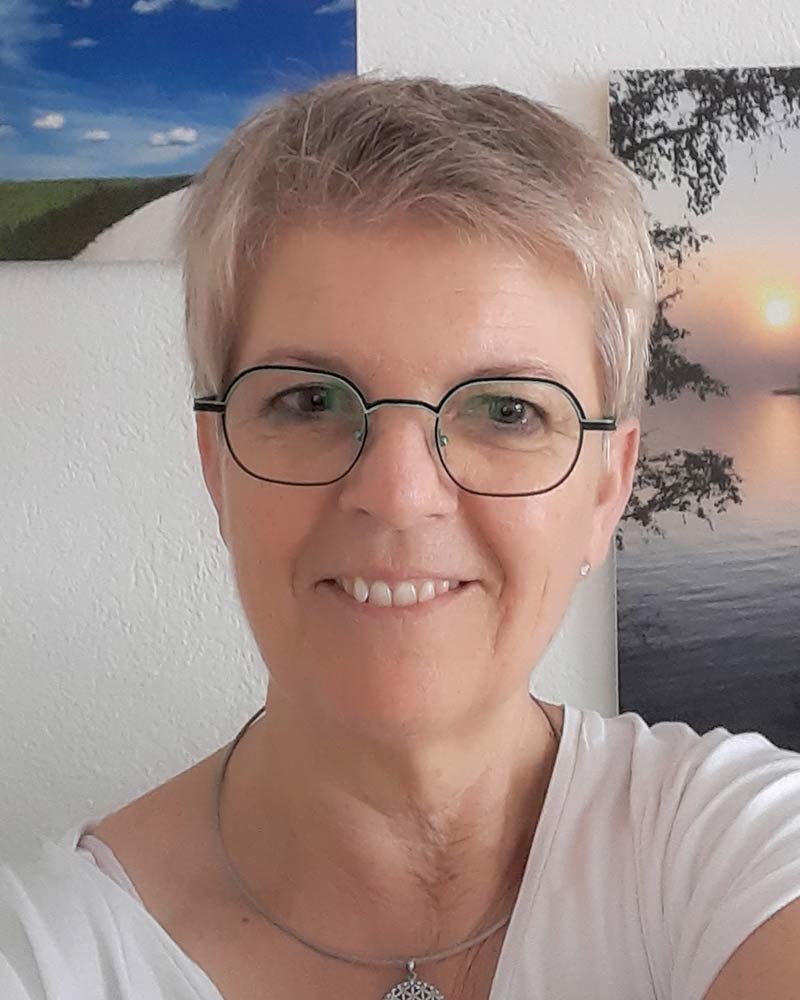
Could you tell us about your Parkinson’s journey? When and how was the disease diagnosed, and how did you take the diagnosis at the time?
I first noticed that something was not right when I was 52, in 2016. At the time, I was working in nursing. There was a moment when I tried to put a key into a lock and noticed that my little finger was trembling. I registered it in that moment, but then I forgot about it again.
A few weeks later, I went for a walk with a friend and noticed that my left leg was not moving quite smoothly. It felt like a gearwheel that would briefly get stuck and then snap back into place. But again, I simply noticed it and then forgot about it.
In November of that same year, the strain of my job and caring for my husband, who also has Parkinson’s, took its toll. I had a breakdown and was diagnosed with burnout. I spent two months in the psychosomatic unit of the hospital, and I told the doctors there that I suspected I had Parkinson’s. But all the doctors agreed — and continued to agree over the next three years — that I was simply taking on my husband’s symptoms and did not have Parkinson’s myself. During that time, I was in a very bad place emotionally.
In 2019, my neurologist finally referred me for a DAT scan – mainly so that I could come to terms with the issue, as he himself was convinced that I didn’t have the disease. But then came the diagnosis: Parkinson’s.
During those three years, my symptoms kept appearing from time to time. I noticed shaky, fluttery legs and could no longer walk as lightly and freely as I used to. All along, I knew: this can only be Parkinson’s. But even my primary care physician could not imagine it. When I confronted her with the diagnosis, she burst into tears and told me that she simply could not imagine that both of us, as a married couple, had Parkinson’s.
How were you treated after the diagnosis? Were there any problems finding the right medication regimen?
For the first year, I refused to take medication. After all, I had managed the previous three years without it — so one more year did not make much difference to me. But my walking symptoms worsened, and the burden grew. I started with a quarter tablet of Madopar 125 mg, five times a day.
Today, I take half a tablet five times a day. I also take rivastigmine in the morning and one tablet of Sifrol in the evening. So far, that has worked very well for me. Recently, however, I have noticed that walking is becoming increasingly difficult, that I am very stiff in the morning, and that I usually hit a low point later in the afternoon. It will probably soon be time to adjust my medication again.
Because you had been caring for your husband, you already had long experience with Parkinson’s. Then came your own diagnosis. How did that change your life or your view of the future?
Honestly, it pulled the rug out from under me. We sat together with our children, and it was truly awful. I kept asking myself: Why us? Why both of us? What went wrong? Were we exposed to chemicals?
The question of where it came from and why still occupies me today, but it is no longer nearly as present, because you do not get an answer anyway. I no longer want to waste my time on that. I would rather invest it in the beautiful parts of life. My husband took his diagnosis very pragmatically at the time. The three of us were crying, and he simply said: I am not going to die from this disease. There are people who have a tumor and are dead within six months. But I am not going to die from this disease. I am going to die with this disease. That made a deep impression on me.
Do you still care for your husband at home? What does your everyday life look like now?
No. My husband now lives in a long-term care facility. He was diagnosed ten years ago, and until last year, I still cared for him at home. In 2022, he received deep brain stimulation, or DBS, but unfortunately, it did not bring the success we had hoped for. He does need less medication, but the biggest problem is that he has experienced significant cognitive decline, and it is likely progressing toward Parkinson’s disease dementia.
The caregiving was no longer manageable for me. I was not sleeping at all because he needed help constantly. I believe I would not be alive today if we had not decided last year to sell our family home. I now live in a two-room senior living apartment, and my husband lives 20 meters away in the long-term care facility. The past year was intense. I lost my home, and in a way, I also lost my husband. But by now, we have come to terms with it. We see each other every day, play table tennis together, and visit each other.
How did this double blow affect your family, especially your children?
Our son was 22 at the time, and at first, he fled the situation and pursued tourism training farther away. By now, he has returned, and we have a really good relationship. In the end, it brought us incredibly close together as a family and made us strong. We simply enjoy every moment we are allowed to spend together.
Parkinson’s itself is rarely discussed. Still, my greatest fear is that they could have it too — and I can hardly bear the thought. They could get tested, but both of them have chosen not to. They do not want to know yet, because it would not change anything right now anyway. I simply try to be a role model for my children. I am active and adventurous, and I try to keep enjoying my life. I want to show them that life goes on, even with a Parkinson’s diagnosis. The focus has to be on life and on the beautiful parts of life.
Is there a particular memory or event that makes you especially proud because you managed it despite Parkinson’s?
Absolutely. A ping-pong group grew out of our support group. We found a coach in Lucerne and began meeting and training about every two months. In 2021, we took part in the Ping Pong Parkinson World Championship in Berlin. Our ambition had been awakened, and we continued training diligently. In 2022, the World Championship took place in Pula, Croatia — and I became runner-up in my category. I was incredibly proud of that.
Congratulations — that must have been a wonderful feeling. Do you also train outside the group, and what makes ping-pong so interesting for people with Parkinson’s?
We train twice a week in the group. It is a lot of fun, and ping-pong is a great sport for people with Parkinson’s: hand-eye coordination, reaction time, balance, and plenty of enjoyment. It is ideal training for staying in good shape.
You mentioned a support group. How did you find it, and what role does it play in your life?
A colleague told me about her sister-in-law, who also has Parkinson’s. Silvia Lerch founded a support group in Olten in 2020. Above all, Ms. Lerch’s wonderful commitment is what makes our group so special. We do a lot together. We have already been in a flight tower, and soon we are going to a climbing gym. There is actually something planned every month. I have also found good new friends in the group.
How has your old circle of friends and acquaintances dealt with Parkinson’s?
Some people are simply overwhelmed, of course, which I can understand very well. But we still have a good circle of friends. Communicating with my husband is somewhat difficult because — as is typical for many people with Parkinson’s — he speaks very softly, and of course his cognitive impairment also makes normal conversation harder. But he still enjoys sitting with everyone and being part of the social gathering.
What supportive therapies do you receive in addition to medication?
I always say that the best therapy is my job. I work in an after-school program with school-age children, and there I get to live out my creativity. I have speech therapy when I tell stories. I have occupational therapy when I do crafts with the children. And I have physical therapy when I run up and down the stairs all day. Apart from that, I go to physical therapy once a week. The focus there is on strengthening my back muscles, maintaining posture, training balance, and staying flexible.
Are there everyday situations that are clearly more difficult for you than they used to be? Or are there things you can no longer do?
I no longer like climbing ladders — my balance does not always cooperate. And I no longer go ice skating or skiing. I used to love doing those things, but the fear of falling is simply too great. It is enough for me to go for walks in the woods with the children. Walking on uneven paths and over roots is good training, too. I have never really had a serious fall, and compared with other patients, I have to say I am doing very well.
Have you experienced any misunderstandings about Parkinson’s?
Yes. Here in the building, people have asked me more than once why I am actually here. They say I do not look like I have anything. I have explained to them that even though I do not shake and do not have a tremor, I still have Parkinson’s. When they sometimes see me in the evening, when I walk much worse, they understand it more easily. Many people also confuse Parkinson’s with Alzheimer’s and expect that you will develop dementia.
What would you like to see from medicine or policymakers when it comes to Parkinson’s?
Here in Switzerland, Parkinson’s is not mentioned by Switzerland’s Federal Office of Public Health — I would urgently change that. There should also be much stricter bans on pesticides, because I believe this is one reason more and more young people are developing Parkinson’s. I would like to see more visibility and for policymakers to finally take action. Even my neurologist told me we should go protest.
What advice would you give to people who have recently received a Parkinson’s diagnosis — and to their family members?
I would immediately join a self-help group. There you can see that life goes on, learn how others deal with it and find people who can understand you. And I would communicate openly from the start that you have Parkinson’s disease.
What final piece of advice would you like to share with our readers?
Do not put things off. Do not wait until later — do them now. Make room for joy, and spend your money on things that bring you joy.
Thank you very much for this open and encouraging interview, and we wish you all the best for the future.
More exciting interviews
Good Parkinson’s care does not happen in the doctor’s office alone. Carina Lummer focuses on regional networks that support patients and families beyond clinical care.
Josefa Domingos approaches therapy from an everyday perspective—using creative movement techniques, building rapport with patients, and having the courage to rethink Parkinson’s care.
A brain pacemaker can significantly alleviate Parkinson's symptoms. Dr. Patricia Krause determines who is a candidate for deep brain stimulation.
Silvia Lerch supports young people with Parkinson's through self-help, sports, and education—and shows just how much life is still possible despite an early diagnosis.
The gut may play a more important role in Parkinson’s than previously thought. Dr. Arnout Bruggeman discusses microbiome research and new therapeutic perspectives.
Therapy dog Ludwig brings joy to exercise: Prof. Dr. Carsten Eggers combines dog therapy, motivation, and self-efficacy in the treatment of Parkinson's disease.
When the voice becomes softer, early support is essential. Dr. Tabea Thies discusses speech therapy, communication, and everyday safety.
Speech therapist John M. Dean relies on digital therapy, exercise, and motivation—to ensure that support for Parkinson's disease reaches people where they live.
Martha Strubinger gives Parkinson’s care partners a voice of their own — speaking up about the burdens that often go unseen and calling for greater understanding in families, healthcare, and public life.